Notion AI Assistant: Automate Tasks, Meeting Notes, and Team Knowledge Bases
Notion AI Assistant: Automate Tasks, Meeting Notes, and Team Knowledge Bases
A Notion AI assistant helps founders, agencies, small teams, operations leaders, and customer success teams using Notion for notes, tasks, SOPs, or lightweight knowledge management turn team knowledge into clearer decisions, owners, tasks, and reusable processes. The point is not to add another app for the team to babysit. The point is to make the work already happening in Notion easier to understand, prioritize, and act on.
Notion can hold everything, which is useful until it holds too much. Meeting notes, campaign plans, SOPs, tasks, ideas, and customer insights pile up until the workspace becomes searchable but not actionable.
LeadMagicX fits into this workflow as the AI engine. It helps turn signals, records, messages, and activity into summaries, drafts, task suggestions, and next-step recommendations. Your team stays in control of anything sensitive, customer-facing, financial, or account-changing.
What is a Notion AI assistant?
A Notion AI assistant is a workflow that helps structure messy notes, extract tasks, identify reusable knowledge, and organize information into something the team can execute.
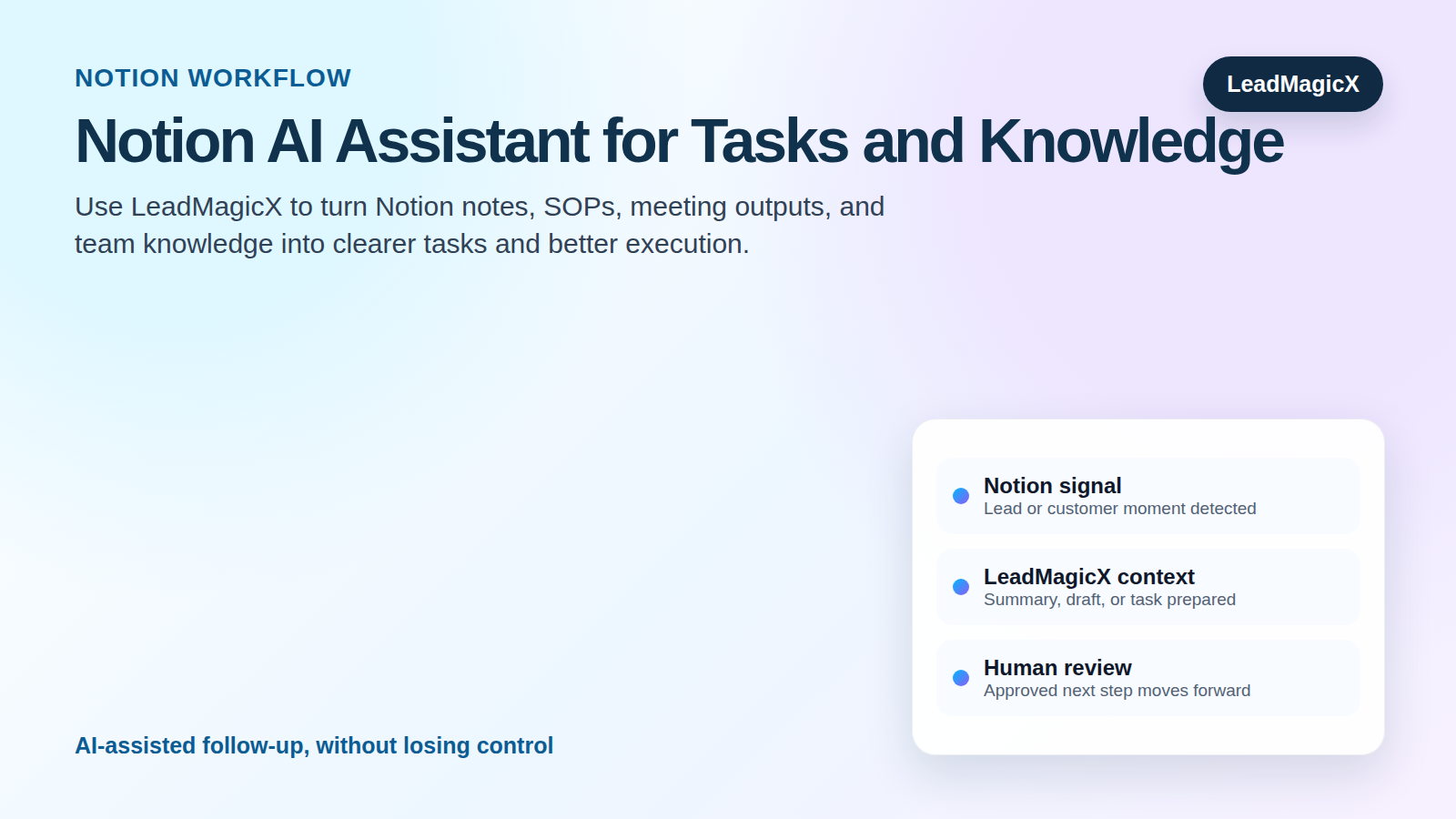
A useful assistant does three things well. First, it notices the right signal. Second, it adds context so the team understands why the signal matters. Third, it prepares a clear next step that a human can review, approve, and execute.
That is different from basic automation. Basic automation says, "If this happens, do that." An AI assistant helps answer a more valuable question: "Given what we know, what should the team do next?" That difference matters because most business workflows are not just technical triggers. They include judgment, timing, tone, ownership, and risk.
Why this workflow matters
Most teams do not lose opportunities because they lack software. They lose opportunities because handoffs are slow, context is scattered, and follow-up is inconsistent. Notion may contain the signal, but the team still needs a system for deciding what it means and who owns the next step.
A LeadMagicX-powered workflow helps reduce that gap. It can help your team move from raw activity to a clear action plan. Instead of relying on someone to manually read every update, remember every policy, and write every response from scratch, LeadMagicX helps prepare the work so the team can move faster.
This is especially valuable when the workflow affects revenue, support quality, customer experience, or operational speed. The goal is not full autopilot. The goal is better execution with less manual sorting.
How the workflow works
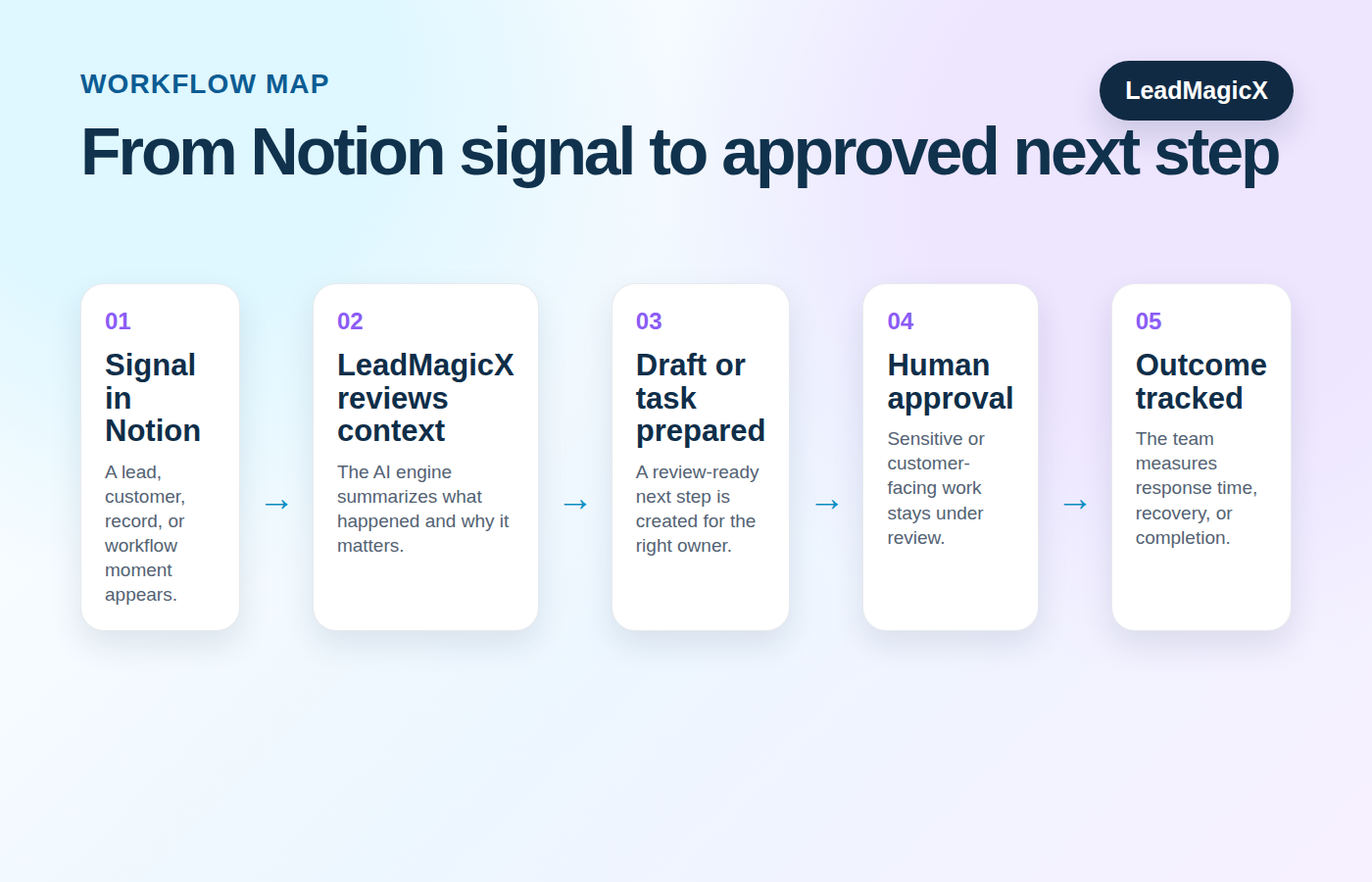
Here is what that looks like in plain English:
- New information lands in Notion, such as meeting notes, a rough SOP, campaign ideas, customer insights, or a messy project page.
- LeadMagicX helps identify what should become a decision, task, checklist, or reusable knowledge base item.
- The team gets structured next steps instead of another page that everyone promises to revisit and then quietly abandons.
- A human reviews anything that becomes policy, training, customer-facing content, or an official process.
- The team tracks whether meetings produce completed tasks, SOPs get used, and repeated questions go down.
For example, a long meeting note is not useful just because it exists. The useful workflow says, “Here are the decisions, owners, deadlines, open questions, and pages that should be updated.”
Best workflows to build first
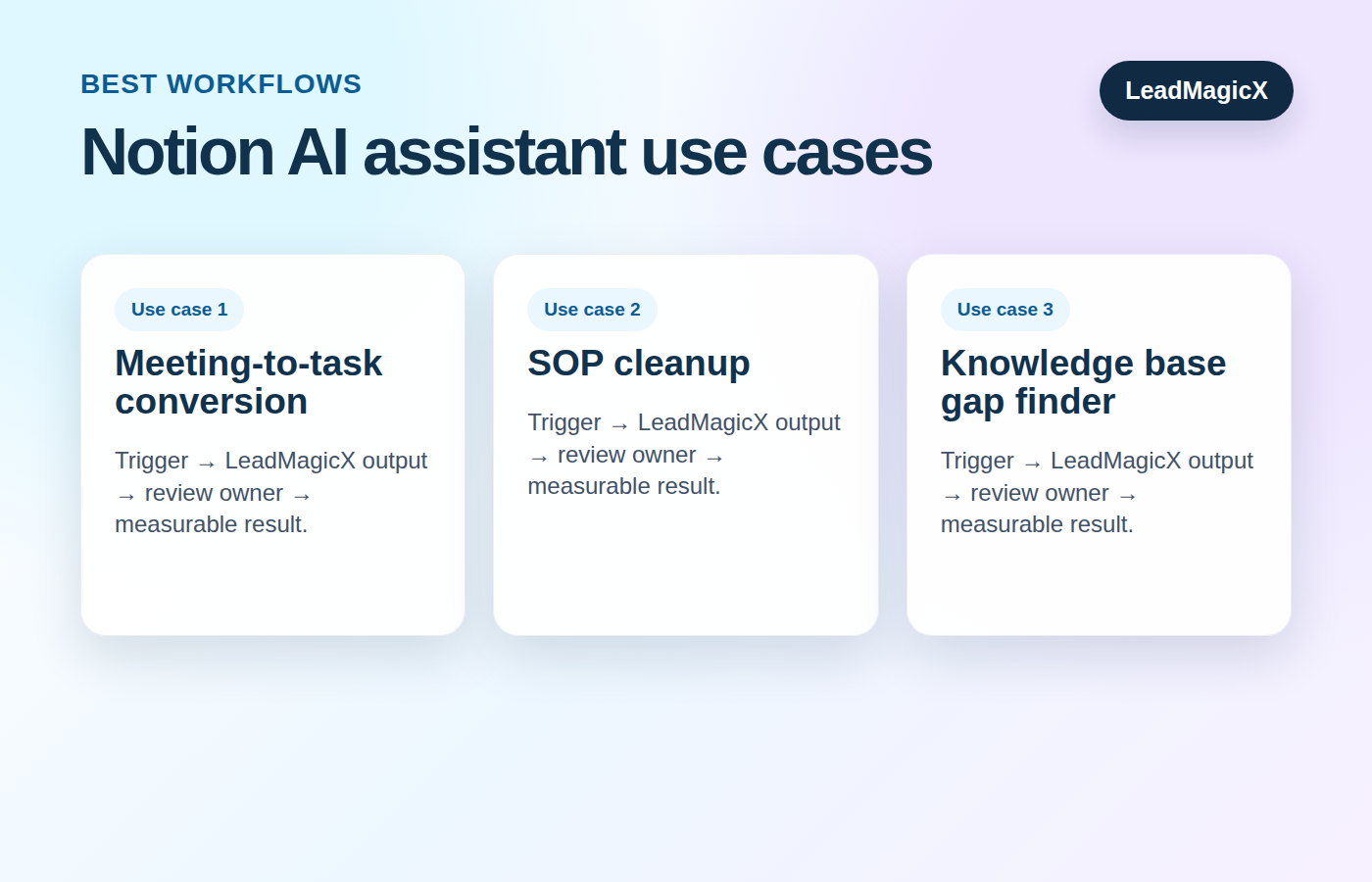
Meeting-to-task conversion
Trigger: A meeting note, transcript, or planning doc is added to the workspace.
How LeadMagicX helps: LeadMagicX extracts decisions, owners, deadlines, open questions, and next steps.
Review point: Meeting owner confirms tasks.
Metric to watch: Task completion after meetings
SOP cleanup
Trigger: A rough process note or training outline needs to become reusable.
How LeadMagicX helps: LeadMagicX turns the content into sections, checklists, decision points, and review questions.
Review point: Process owner approves.
Metric to watch: SOP usage rate
Knowledge base gap finder
Trigger: The team keeps asking the same questions across notes or channels.
How LeadMagicX helps: LeadMagicX suggests pages that should exist and drafts outlines for them.
Review point: Team owner validates accuracy.
Metric to watch: Repeated-question reduction
Start with one of these workflows, not all of them at once. The fastest way to make AI automation disappointing is to make it too broad too early. Pick one signal, one owner, one output, and one success metric. Once that workflow is reliable, expand from there.
Implementation blueprint
- Pick the business moment that matters most. For example, a new lead, a missed appointment, a support request, a payment issue, a reporting change, or a task handoff.
- Define the signal in plain English. If your team cannot explain the trigger clearly, the automation will not be clear either.
- Decide what context LeadMagicX should use. This might include recent activity, notes, source data, approved messaging, or previous outcomes.
- Choose the output. The safest starting outputs are summaries, drafts, task suggestions, and review-ready recommendations.
- Set the human review rule. Anything public, sensitive, financial, account-changing, or strategic should stay under review.
- Assign ownership. A workflow without an owner is just a very organized way to ignore something.
- Track one metric. The workflow should improve response time, completion rate, recovery, conversion, quality, or another measurable outcome.
What LeadMagicX should handle
LeadMagicX should help with the thinking layer of the workflow: summarizing context, identifying intent, preparing the first draft, recommending a next step, and organizing the handoff. That is where AI creates leverage without removing human judgment.
For a Notion AI assistant, the strongest use cases usually involve prioritization and preparation. LeadMagicX can help your team understand what happened, why it matters, and what should happen next. That makes the team faster without forcing them to trust a workflow they cannot inspect.
What should stay in Notion
Notion should keep its core job. Do not use an AI assistant as a replacement for the system that owns the original data. If the workflow depends on an email, appointment, invoice, campaign, order, row, note, or CRM record, that source should remain traceable.
This is also important for trust. A prospect or customer does not care how clever the automation is if the follow-up is wrong. The workflow should make the team more accurate, not just busier at a higher speed.
Human review and safety guardrails
Keep human approval in place for:
- Customer-facing messages
- Billing, invoice, refund, cancellation, or payment-related communication
- CRM field changes or account updates
- Ad budget, campaign, or targeting decisions
- Legal, compliance, policy, or pricing language
- Any response that could affect customer trust
This does not make the workflow slower. It makes the workflow usable. LeadMagicX can prepare the work, surface the context, and recommend the next step. The human reviewer confirms accuracy and tone before the action goes live.
Example workflow
A team finishes a planning meeting with a long note and no clear owner list. LeadMagicX can help extract the decisions, actions, due dates, and open questions so the meeting turns into execution instead of a beautifully formatted memory.
That is the practical value of a Notion AI assistant. It does not just connect systems. It helps your team make a better decision at the moment when action matters.
Mistakes to avoid
- Turning every note into another page with no owner
- Publishing AI-written policy without review
- Creating tasks without deadlines
- Losing links back to source notes
- Letting the workspace become a prettier junk drawer
A good AI assistant workflow should feel calm and useful. If it creates more alerts, more channels, more review confusion, or more cleanup, it is not solving the problem. It is just adding glitter to the bottleneck.
Metrics to track
- tasks created from meetings
- task completion rate
- SOP adoption
- repeated-question reduction
- time saved finding information
Pick one primary metric for the first version of the workflow. Once the workflow is stable, add supporting metrics. For example, response speed is useful, but response quality matters too. Task volume is useful, but completed tasks matter more. Reports are useful, but decisions made from the reports matter most.
FAQ
Is a Notion AI assistant the same as basic automation?
No. Basic automation follows rules. A useful AI assistant adds context, prepares a recommendation, and helps the team decide what should happen next.
Should the workflow take action automatically?
Start with review-ready outputs. Summaries, drafts, task suggestions, and team recommendations are safer first steps. Live actions should only be used when the workflow, permissions, and approval rules are clear.
What is the best first workflow to build?
Start with the workflow that has a clear trigger, a clear owner, and a measurable business outcome. The best first workflow is usually the one where slow follow-up is already costing time, revenue, or customer trust.
How does LeadMagicX fit into this?
LeadMagicX acts as the AI engine that helps interpret context, prepare next steps, and support execution. The connected app remains the place where the original signal or record lives.
Related LeadMagicX reading
If team knowledge and project notes are becoming an AI workflow, these related LeadMagicX articles are useful next reads:
- see how LeadMagicX is evolving into AI-powered teams
- understand the 3-piece powerhouse behind LeadMagicX
- supercharge your content strategy with LeadMagicX
Ready to build a smarter workflow?
Use LeadMagicX to make Notion more actionable, more organized, and easier for your team to execute from. Start with one high-value workflow, define the signal, keep human review where it matters, and measure the outcome. That is how you turn an AI assistant from a nice idea into a business system your team will actually use.